
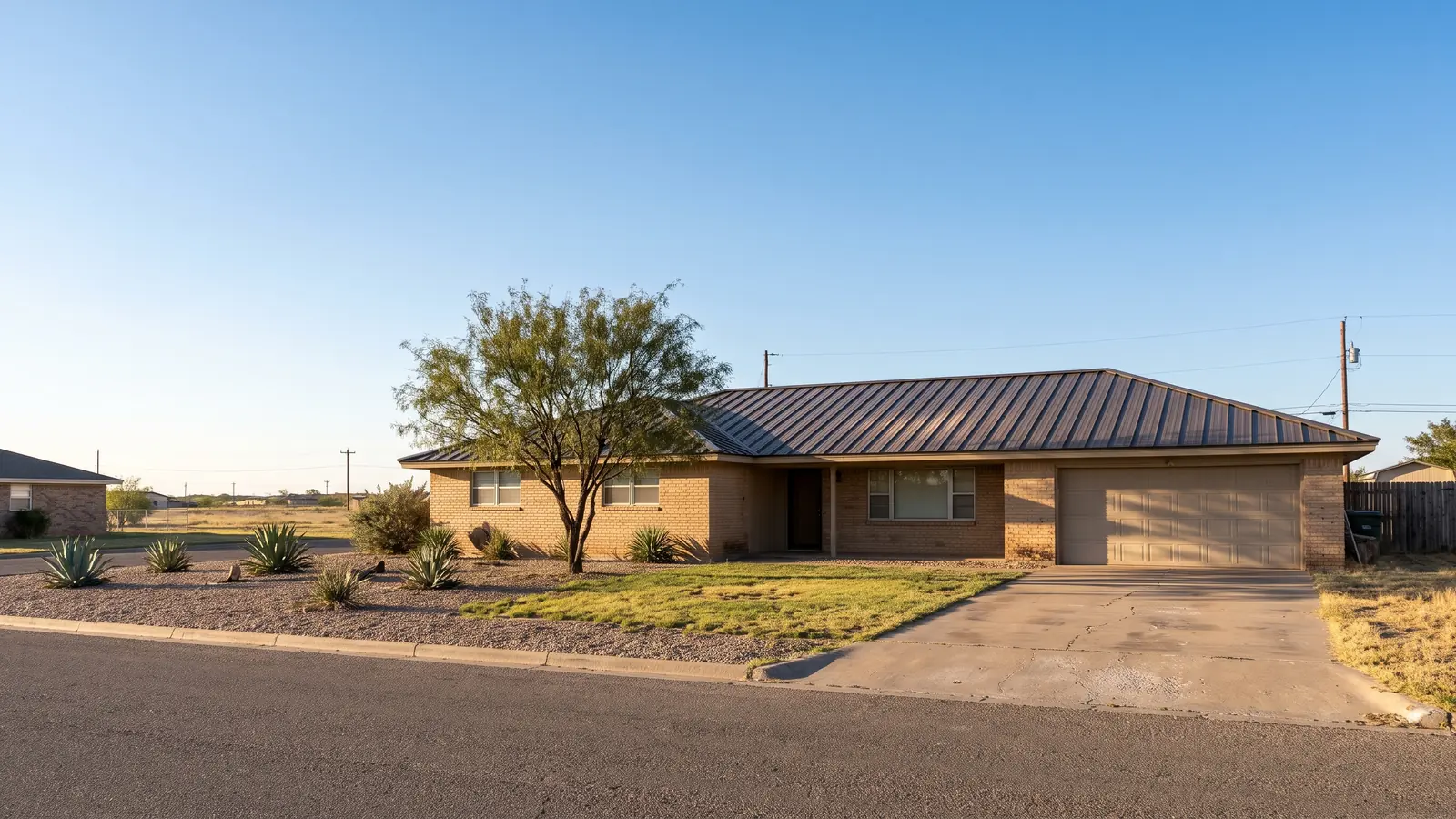
Commercial Metal Roofing by Building Type in Midland
A commercial roof often sits on purlins instead of plywood. It may carry HVAC units and skylights, and the building usually stays open while the crew works. Each building type below changes how a roofer should plan the job.

Warehouses and Oilfield Yard Buildings
Warehouses, equipment barns and yard offices are mostly pre-engineered steel with screw-down panels on purlins. The code allows that: metal panels can go on spaced supports when the panel is designed for it, instead of a solid deck. The common problems are loose fasteners, rusted laps and worn-out skylight panels. On a sound building a retrofit or a coating often costs less than a tear-off. For a straight re-sheet on a steel building, see metal building roofs.

Retail and Strip Centers
A strip center often has a flat membrane roof behind a metal mansard or parapet facade. You can replace either part on its own. Tenants stay open, so ask for a phased schedule and a plan for keeping the entrances clear of debris. SquareDash prices standing seam at $8 to $12 per sq ft for retail and mixed-use buildings.

Churches and Schools
A church roof is often steep and on show, while a school is more likely to have wide low-slope sections. Both have fixed calendars. Work around services, events and the school year, and get the written scope in front of the board or committee early.

Offices and Multi-Family Buildings
Offices and apartments need a roof crew that can work around occupied units, parked cars and rooftop equipment. Ask how they'll protect the HVAC units, keep the site safe around residents and handle the drip edges and gutters over doorways. MBCI, a panel maker, says existing rooftop units, vents and light panels can be worked into a retrofit system.

Standing Seam Retrofit Over an Old Roof
A retrofit puts a new metal roof on top of the old one instead of tearing it off. On a flat roof, light-gauge steel framing builds a new slope above the old membrane. On an old metal roof, new panels can fasten through the old ribs into the purlins. The old roof keeps the building dry during the work, and there's no tear-off to haul away.
- Framing: 16 to 12 gauge light-gauge steel (MBCI)
- Low-slope retrofit: under 2:12, chosen to save money and shed water
- Screw-down retrofit panels: about 12 in rib spacing, minimum 1/2:12 slope; old lap screws come out first
- Insulation: unfaced fiberglass in a vented cavity between the two roofs works at 3:12 or steeper
Why Midland homeowners call Midland Metal Roofing
- Free quotes, no obligation to hire
- Panel, gauge and price in writing before any work
- Your request goes to one Midland roofer, not a call list
- Homeowners never pay us for the referral
Commercial Roof Recover Rules in Midland
Midland's adopted commercial code is the 2018 IBC. Its reroofing section decides whether the old roof can stay:
Replacement
means stripping every layer down to the deck.A recover is allowed
when it follows the manufacturer's instructions. A standing seam system that carries its loads straight to the structure doesn't need the old roof removed.No recover
over a roof that is water-soaked or too deteriorated to work as a base, or over two or more existing layers.Coatings
can go over existing metal panels without a tear-off.The structure
has to carry the new covering plus the crew's material and equipment while the job is underway.Rusted flashings,
edgings and counterflashings can't be reused.
Ask for an engineer's review of the framing on any retrofit. Before you sign, ask which of these rules the bid assumes. A bid that leaves out a second roof layer or a wet section is one you'll pay for later. The residential side of the same rule is on our metal roof over shingles page. For a restoration instead of a new roof, see metal roof coating.
Hail and Heat on Midland's Flat and Low-Slope Roofs
Big low-slope metal roofs take the worst of spring hail and summer sun. After a storm, have the roof inspected and photographed before you file a claim. Our hail damage page covers the Texas claim rules. Screws and sealants fail first on exposed-fastener roofs, so ask how many fasteners the bid replaces. The screw replacement page explains why the replacements go up a size.